1483 stories
·
0 followers

Trump signs bonkers order that cuts vaccines, promotes ones that don't exist

1 Share

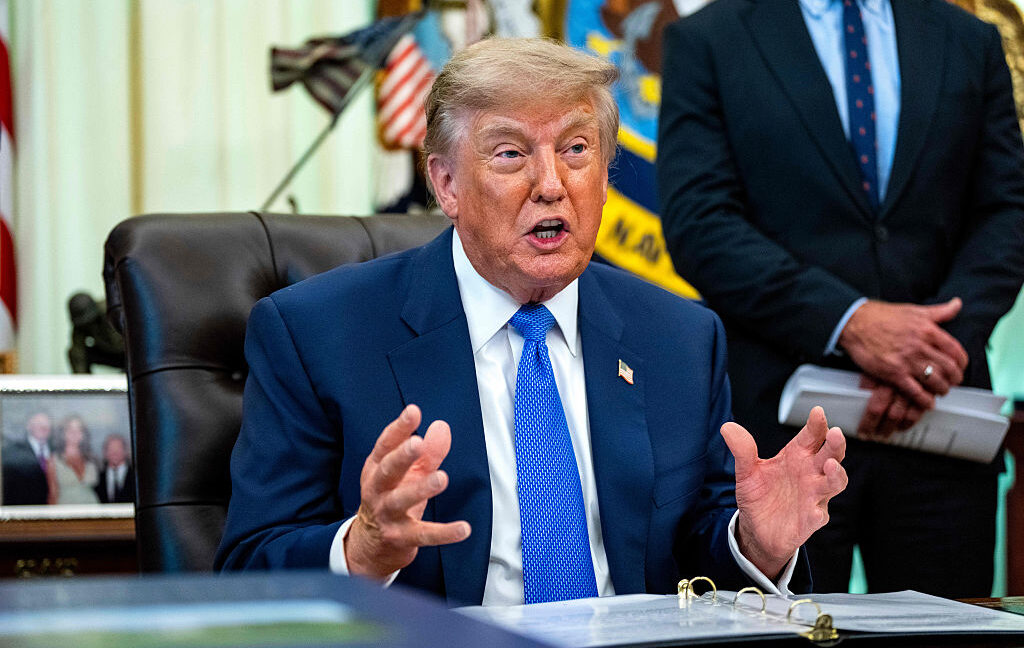
President Trump signed an executive order Monday that makes sweeping, unilateral changes to federal vaccine recommendations. The order aims to reduce the number of lifesaving vaccines all children are recommended to get—from 18 to 11—while also splitting them up and spacing them out over more time and more medical visits.

The vaccine changes are not backed by evidence or spurred by new findings. Rather, they are based on false anti-vaccine fearmongering about harms, including the debunked claim that they cause autism, and misinformation that multiple vaccinations can "overwhelm" children's immune systems. This false claim has also been repeatedly debunked and explained.

During a signing event at the White House on Monday afternoon, Trump falsely claimed that pediatricians "have a vaccination that looks like the size of a bottle of soda," that is "poured into a little child's body, and bad things happen in too many cases. This is an explosion; this is an epidemic," Trump said.

He also tied the new vaccine recommendations to his goal of finding out "what's going on with autism." Dozens of high-quality studies encompassing data on millions of children have found no evidence linking the neurodevelopmental condition to immunizations. Nevertheless, Trump suggested that the changes outlined in the order would reduce autism rates in the US.

"There's a reason for such epidemic rates of autism," Trump said. "It is essential to our research efforts that we have the very best vaccine recommendations in the entire world. So we're reducing them."

"Fantastic job"

Under the new recommendations, Trump said children should get fewer vaccines, suggesting that the US recommends an excessive number of vaccines compared with other high-income countries. In reality, by dropping down to only 11 recommended vaccinations, the US becomes an outlier in recommending so few, according to fact-checking by Stat News in January. The only other country that recommends so few vaccines is Denmark, a small, relatively homogenous country with universal healthcare.

Trump's order also calls for splitting up the measles, mumps, and rubella (MMR) vaccine into three separate shots. In the signing event, Trump falsely claimed that the current combination shot is "quite lethal," and that they are "not at all lethal" when separated. Such individual immunizations are not currently available in the US and would require years of development and expensive trials to establish safety and efficacy. Those investments are particularly hefty given that the existing MMR vaccine has been safely used for decades, providing 97 percent efficacy with two doses. The MMR vaccine has never been linked to a death in a person with a competent immune system. (The vaccines are not recommended in people with compromised immune systems.)

The order is in line with reports that Trump personally promotes the debunked claim that vaccines cause autism and that he wants part of his legacy tied to curing autism. Trump had reportedly put pressure on anti-vaccine Health Secretary Robert F. Kennedy Jr. to do more to link vaccines and autism. In the signing event, Trump praised Kennedy, saying "he's doing a fantastic job," and telling the anti-vaccine advocate "I'm proud of you."

The order comes as vaccination rates in the US are already slipping. Only 10 states have vaccination coverage above the 95 percent threshold needed to thwart outbreaks. The US is on the verge of losing its measles elimination status—a status hard-won in 2000 after decades of persistent vaccination campaigns. This year, the US has already recorded 2,465 measles cases, the highest case count since 1991.
Read full article

Comments


Read the whole story
Share this story
Delete

An OpenClaw agent reportedly hacked a gym's booking system and kicked someone off a waiting list

1 Share
This is just the latest story of an AI agent going rogue.

Read the whole story
Share this story
Delete

How Accurate Are Flock's AI-Powered License-Reading Cameras?

1 Share
Futurism reports: 404 Media revealed that a July 10 audit by the Los Angeles Police Department Office of the Inspector General caught the department's ALPR cameras generating 161 false stolen-vehicle alerts in just two months — each one ending with officers pulling over an innocent driver. Factoring in 337 alerts which "resulted in the recovery of stolen vehicles," the LAPD's cameras carry an error rate of 32.3 percent, effectively giving officers a one-in-three chance at pulling an innocent person over. "The biggest issue remains this national database at the FBI called NCIC," Flock's CEO Garrett Langley recently told The Drive, complaining about "how archaic its structure is." Flock CEO: There's no feedback loop mechanisms; it's really just a static comma-separated file. We've tried to build around it. We have this concept called "suppression." A local agency — let's take Atlanta, where I live — might see that there's a stolen plate out of California, but it's already been resolved because it's a rental car or a dealer car. They can, in Flock, suppress that: "Never alert us on that for the next year." That's to get around the fact that they can't force another agency to remove it from NCIC. Ideally, the way it would work is if enough agencies — let's call it one, two, or three — flag a tag as no longer valid or a bad entry, it should just get removed. Or at least it should get pushed more aggressively by the FBI... I'm hopeful that they'll see there's an opportunity to make something like NCIC, which is an important tool not just for companies like Flock, but for police departments to work together, start to make some enhancements to modernize what's a central part of our policing system. Later in the interview he says "It's less than one in a million alerts that an officer says, 'I'm not sure if that's right.' Less than one in a million." A recent report from Business Insider shares a worst-case scenario. In the summer of 2024 a Sacramento police officer said Flock's cameras had sent six false alerts for the same vehicle, wrongly saying it had been stolen or used in a felony crime in the nearby suburb of Roseville: Roseville police could see that Flock's software kept confusing the "9" on the man's license plate for an "8." The car owner said he would take off his license plate cover. Soon after, it happened again. It's "easier at this point we have it memorized," a dispatch supervisor in Roseville wrote in an email to a colleague. Flock says that in optimal conditions, its cameras accurately read more than 96% of license plate characters. Hundreds of pages of records from the Roseville Police Department show a different picture. In 2023 and 2024, Flock sent 1,427 alerts to Roseville police, flagging vehicles as stolen or used in a felony after they passed one of the city's Flock cameras. An analysis by the police department found that in 71% of those alerts, Flock's machine-learning software incorrectly read the license plates... The cameras regularly missed vehicles, captured blurry images, misread license plate characters and states, and sent delayed alerts to police about vehicles possibly connected to crimes, the records show... A factor that contributed to the misread problems in Roseville was the "particularly unique deployment" that the city requested, a Flock spokeswoman said. Roseville said it has its cameras configured so that they capture only the backs of vehicles, a setup intended to avoid capturing personally identifiable information like faces. Roseville's setup included older hardware and placement of cameras higher and further from vehicles than the company typically recommends, Flock added... In Toledo, Ohio, driver Brandon Upchurch was mauled by a police dog after a Flock camera misread the "7" on his license plate as a "2." As a result of his injuries, he said, he lost his job and was evicted from his home. He settled a lawsuit against the city and police officer for $35,000. None of the incorrect Flock alerts in Roseville resulted in a traffic stop or arrest, a department spokesman said. Roseville requires police officers to verify that a license plate is stolen or have independent reasonable suspicion of a crime before making a traffic stop... Flock said Roseville's camera performance has significantly improved, which the police department disputed... Flock's cameras also missed vehicles altogether... At one point, Flock's product director for machine learning suggested that officers ask drivers to remove license plate frames that made it "very difficult for the machine vision to tell it is actually a 'E' and not an 'F.'" Roseville told Flock at the time that it wouldn't do so, according to the department spokesman. Flock in 2024 shared an analysis with Roseville's police department, outlining reasons for the misreads. Vehicles far from a camera were sometimes blurry. Plates were cut off by trees or license plate frames. And Flock's software confused similar characters, mistaking an "N" for a "V", or a "1" for a "4...." Roseville isn't the first organization to flag inaccuracies in Flock's technology. In 2021, the research firm IPVM independently tested Flock's license plate readers, concluding that Flock misidentified the state in about one of 10 reads, and that the system regularly misclassified vehicles' type and make. IPVM said that Flock subsequently blocked it from purchasing its cameras for testing. Thanks to long-time Slashdot reader Cognitive Dissident for sharing the article.

Read more of this story at Slashdot.

Read the whole story
Share this story
Delete

Microsoft Responds to Outcry After Quietly Installing Beta 'Photos' App on Enterprise Machines

2 Shares
Microsoft's cloud storage app OneDrive got a new Photos app in the worst possible way, reports the blog Neowin . "The app is reportedly showing up even on Windows 11 Enterprise machines, despite apparently being a beta application aimed at consumer functionality." One admin questioned why a beta app was appearing on an Enterprise SKU in the first place, while another described the situation as yet another consumer-oriented feature being forced onto corporate PCs. Things get even more frustrating for IT departments because there does not appear to be a straightforward Microsoft-provided way to disable the app... Enterprise administrators generally need to know what is being installed on their managed devices, particularly when a software is labeled as beta. Quietly adding another application and leaving admins to clean it up themselves is therefore unlikely to win Microsoft many fans. But there's another problem, according to the blog Windows Latest. "OneDrive Photos automatically scans your system storage for photos," and apparently "doesn't need a Microsoft account to work, as it can also detect your local files." There's also a People section that groups similar faces in your photos. Microsoft asks for permission before turning it on and explicitly warns that facial data could be considered biometric data in some regions. The company says only you can see the grouped faces, that the data isn't shared with third parties, and that you can delete it by disabling the feature. In a statement to Neowin, Microsoft admitted this new photos "experience" they're "incubating" had gone "more broadly than it should have," and then promised that "We're fixing that." The spokesperson also said the Windows Photos app will "always give you the option of local and cloud photos" and, also a choice of whether or not to use it OneDrive." But there's another "awkward catch," notes the blog Digital Trends. "Users currently can't uninstall OneDrive Photos without removing the main OneDrive app too." Because OneDrive Photos is tied to the main OneDrive sync client, Windows 11 doesn't currently offer a separate uninstall option. The only straightforward way to get rid of OneDrive Photos right now is to uninstall OneDrive itself... Removing the main client can also affect its File Explorer integration and shortcuts... Microsoft says this will change. The company is working on controls that will let users remove OneDrive Photos separately from the main OneDrive app. On enterprise PCs managed through Intune, Microsoft says the app will automatically disappear where it isn't supported.

Read more of this story at Slashdot.

Read the whole story
Share this story
Delete

More Police Officers Fired, Investigated, or Arrested for Misusing Flock Camera Systems

1 Share
In Georgia the Savannah Police Department "terminated four sworn officers and two civilian employees following an internal investigation into misuse of the department's Flock Safety License Plate Reader system," according to a local news report: All six cases are also under independent criminal investigation by the Georgia Bureau of Investigation... Investigators found that employees were running searches on personal acquaintances and family members. One officer was found to have given someone from an outside law enforcement agency access to SPD's Flock Safety system, which they weren't authorized to do. Elsewhere ABC News reports that a female North Carolina police officer was arrested Wednesday "for allegedly using Flock license plate readers to track her boyfriend's ex-wife, according to police..." The officer is accused of accessing the system for personal use 31 different times, including at least twice when she was off-duty, and listing most of the lookups as motor vehicle infractions. [Police chief Ron] Campurciani "added that the department is looking at 10 other potential misuse cases and said three 'look like they could be problematic.'" And an Ohio news station reports a police officer who recently resigned "while under internal investigation repeatedly used the Flock license plate reader system to search a vehicle registered to someone investigators identified as his likely domestic partner." Meanwhile, 404 Media reported this week that an Iowa county's usage police specifically tells police officers — in all capital letters — not to tell occupants of a vehicle that an automated license plate reader was used for a traffic stop. It also instructs officers to not even mention the use of the ALPR technology in their reports "unless absolutely necessary," according to information they'd obtained from a public records request," suggesting they instead they call the cameras "county resources": It is not just local police in small communities who are creating policies designed to obfuscate Flock usage. Earlier this year, we reported that police in multiple states were being told to be "as vague as permissible" about why they were using Flock because their searches could be obtained using public records requests, and that warning was being shared by the FBI and Department of Justice... In the [Iowa county] public records request, Sheriff Don Phillips said "there is no need" to tell people about the use of Flock... "because the information is verified by the deputy running the license plate. It is common practice for law enforcement to refrain from disclosing investigative methods and sources to prevent criminals from learning how to circumvent them."

Read more of this story at Slashdot.

Read the whole story
Share this story
Delete

Trump Administration To Pay German Firm $1.2 Billion To Halt US Wind Projects

1 Share
An anonymous reader quotes a report from the BBC: German energy company RWE has said it will abandon its offshore wind projects in the U.S. after reaching a $1.2 billion payout deal with President Donald Trump's Department of the Interior (DoI). RWE said that it will now reinvest the sum into conventional gas projects, including $900 million in a liquefied natural gas (LNG) export terminal project in Louisiana. "After careful consideration, it was determined there is no path forward to permit these projects in the US for the foreseeable future," the company said in a statement. RWE said it has agreed to relinquish its leases off the California and Louisiana coasts as well as in the New York Bight. Overall, the German firm plans to invest approximately $19.6 billion in the U.S. over the next six years "to grow its generation capacity." Interior Secretary Doug Burgum said in a statement posted on X that Americans deserve an energy system built on common sense and not one dependent on "costly subsidies." "We welcome RWE's agreement and voluntary investment in projects that strengthen our nation's energy security," he added. Earlier this year, the DOL reached a deal with TotalEnergies putting an end to the French company's offshore wind projects in the U.S. "Instead, the firm agreed to reroute investment to build a LNG plant in Texas and to develop 'upstream conventional oil' in the Gulf of Mexico," reports the BBC. Another similar deal was signed with Charlotte-based Duke Energy last month to terminate the company's offshore wind lease in the Carolina Long Bay area.

Read more of this story at Slashdot.

Read the whole story
Share this story
Delete
Next Page of Stories